


Manas National Park in India’s Himalayan foothills was once home to some 100 Indian rhinos, almost all of which were wiped out by poaching by the late 1990s. After a campaign to reintroduce them, the population is growing and several calves have been born. But their recovery still needs active support, reports contributor Sneha Mahale for Mongabay India.
Researchers followed the fate of 42 greater one-horned rhinos (Rhinoceros unicornis) reintroduced to Manas in the state of Assam from 2006-2021. The rhinos arrived there in one of two ways: 22 wild rhinos were translocated from other protected areas in Assam, and 20 injured or orphaned rhinos were rescued and rehabilitated at a center, then released into Manas.
The rhino reintroduction program is showing hopeful signs, the decade-long study found. Between 2012 and 2022, the researchers recorded 35 rhino births in Manas: 19 calves from translocated females, and nine from rehabilitated individuals. First-generation rhino females, born in Manas, also birthed five calves; the mothers of two more calves remained unidentified.
“Breeding and calving are among the most important indicators that reintroduced rhinoceroses have adapted well to their new environment,” study lead author Deba Kumar Dutta, a wildlife biologist and member of the Asian Rhino Specialist Group at the IUCN, the global wildlife conservation authority, told Mongabay India.
The study also found the two groups of rhinos settled in different parts of the national park. Translocated rhinos spread out over a larger area, often using remote or less-disturbed parts of the park, while rehabilitated rhinos were largely in central areas, giving birth close to antipoaching camps and zones with regular human presence.
“Rehabilitated rhinos are often human-imprinted and tend to remain close to human-inhabited areas within protected areas,” Dutta said. “At times they may even move towards nearby villages, mingling with cattle during the night and returning to the park in the morning. Translocated rhinos, captured from the wild and released into natural habitats, generally retain their natural behaviour.”
While the births of calves over the years is a hopeful sign, experts said the rhino population in Manas still needs continued management. Poaching, for example, led to the loss of some male rhinos in the early years of reintroduction, which disrupted breeding. Researchers also warn that the small, reintroduced population may face risk of inbreeding from a small genetic pool.
Yadvendradev Jhala, retired senior scientist and dean at the Wildlife Institute of India, said the rhinos of Manas should be managed as a metapopulation connected with those in nearby protected areas such as Kaziranga National Park and Pobitora Wildlife Sanctuary in Assam, as well as other populations in the adjoining state of West Bengal.
Dutta said Manas’s grassland habitat also needs active management, including removal of invasive plants and maintenance of perennial water sources.
Read the full story by Sneha Mahale here.
Banner image: A rhino mother and calf in Manas National Park. Image courtesy of Deba Kumar Dutta.

The intersection of environmental breakdown, climate change and economic instability has emerged as a primary threat to the resilience of smallholder farmers in Indonesia, according to researchers and local entrepreneurs who spoke at a recent convention.
During the 2026 Asia Grassroots Forum, held in Jakarta on June 3 and 4, Alex Arnall, an associate professor for environment and development at the University of Reading, U.K., said climate change has become an “agent of exclusion,” creating a “double exposure” for farmers who must simultaneously navigate global market volatility and erratic weather. The Asia Grassroots Forum focused on building sustainable business ecosystems for smallholders.
Previous research showed extreme weather events can affect farmers in southeast Asia by damaging crops, agricultural infrastructure like irrigation systems and farm equipment, and by increasing operational costs and reducing revenues. A 2024 report found that every 1% increase in average temperature raises the price of food production by 1% to 2% across Indonesia, Thailand, Vietnam, Malaysia and the Philippines. Researchers have also noted that smallholder farmers in the region face a massive financing gap, with less than one-third of the $100 billion needed annually for climate-smart adaptation, leaving them in urgent need of better access to credit, insurance and targeted financial support
Drawing on his work with salt farmers in Thailand, Arnall described how even highly-skilled, traditional producers are seeing their knowledge “undermined” by sea-level rise and coastal change. “Farmers in many places … are losing trust in the weather patterns as they become more unpredictable,” Arnall said.
Michelle Arsjad, CEO of the seaweed biotechnology company AquaBloom, said at the panel that she’s seen the impacts of climate change on two vulnerable groups: Seaweed farmers and land-based farmers.
Mongabay previously reported that unpredictable monsoon winds and unusually warm waters trigger bacterial infestations that attack commercially valuable Eucheuma cottonii seaweed. Farmers are then forced to harvest the seaweed prematurely, which fetches a significantly lower price at the market, trapping them in a cycle of shrinking yields and lower revenues.
For land farmers, Asrjad said the crisis is equally unpredictable. She said land farmers increasingly “don’t believe in seasons anymore,” struggling to protect staple crops like rice and chili from drought during monsoons and heavy rainfall during dry seasons.
For Arsjad, the role of a modern agricultural business like hers is to act as a buffer against the intersecting shocks from climate change and price volatility. So, AquaBloom utilizes seaweed-based biostimulants to help crops resist climate-induced stress, which increases yields by 20–30%, she said. This approach supports farmers whose local knowledge is being rendered obsolete by shifting climates, according to Arsjad.
Banner image: Panelists sit during a discussion on how to build inclusive agriculture at scale. Michelle Arsjad (second from left) and Alex Arnall (third from left) are among the speakers. Image by Naina Rao.

Colombia passed a landmark law June 4 aimed at improving traceability of its cattle supply chain to ensure beef isn’t sourced from deforested land.
The law hopes to enhance existing traceability systems and make it easier to identify when cattle have grazed in protected areas and forests that were illegally cleared for pasture.
“This is the most powerful tool for determining whether the meat people consume comes from deforested areas,” said representative Juan Carlos Losada, one of the law’s sponsors, in a post on X.
About 54% of Colombia’s total land area is covered by forest, that’s roughly 60 million hectares (148 million acres). Deforestation has ebbed and flowed in recent years, declining in 2023, spiking in 2024 and then declining again in 2025. Cattle are always one of the main drivers.
The country has over 29.7 million heads of cattle, according to last year’s estimates from the Colombian Federation of Cattle Ranchers.
To better regulate the industry, lawmakers tried to pass traceability legislation in 2021 and 2022 but failed to move it through Congress. Another version took too long to reach a final debate in the senate, and expired in 2024.
The effort began around the same time that the European Union Deforestation Regulation (EUDR) was passed. Once implemented, the law will require that companies trading with the EU demonstrate their cattle and other commodities weren’t sourced from deforested land.
The law allows officials to establish “high surveillance zones” in deforestation hotspots. It includes the ability to implement special control measures and additional monitoring, registration, and control of cattle movements and inventories.
The work will be carried out by the Colombian Agricultural Institute (ICA), the country’s agriculture and livestock agency, in coordination with the National Council to Combat Deforestation.
The law also requires different parts of the government to integrate existing monitoring and traceability systems and take steps to improve coordination.
Over the next six months, the Ministry of Agriculture and Rural Development must also develop regulations for a certification that identifies producers whose products aren’t linked to deforestation. Though, the law doesn’t specify the requirements needed to obtain the deforestation-free certification.
Cattle producers aren’t the only group with new responsibilities. Over the next two years, slaughterhouses, meat processing facilities, livestock auction houses, cattle traders, and live-cattle exporters must also implement due diligence policies and best practices for ensuring their products aren’t linked to deforestation.
Conservation groups said if the law works as intended, the country could make unprecedented progress in the fight against illegal deforestation.
“Colombia is setting an example for the region and for the rest of the world,” said Susanne Breitkopf, the director of forest campaigns at the Environmental Investigation Agency, in a statement. “This law can ensure that beef sold in Colombian supermarkets does not come from deforested rainforest areas or from places where deforestation finances illegal economies.”
Banner image: Cattle graze on land near the Indigenous community of Maticurú. Photo by Edilma Prada Céspedes.

NAIROBI, Kenya (AP) — Kenya’s former Chief Justice David Maraga said he was arrested Monday alongside other activists protesting planned construction inside Nairobi National Park.
Police fired tear gas canisters at the protesters who were marching outside the park while carrying banners with messages denouncing land grabs.
Maraga was detained and later released while staging a sit-in on a major road outside the national park’s main gate. He was wearing a green T-shirt similar to those worn by other activists.
The police have yet to comment on the reason for his arrest.
Maraga wrote on X that he was arrested while heading to present a petition to the Kenya Wildlife Service.
“Our national heritage and environment must be safeguarded from greed and unnecessary destruction without public participation,” he said.
Hundreds of activists joined the protest against the planned construction inside the park and the relocation of an orphanage, calling it an attempt to grab public land.
Kenya has experienced incidents of land grabbing in the past, and environmentalists have often spoken out when parks and other green spaces are encroached upon.
Amnesty International in Kenya expressed solidarity with the protesters and called for members of the public to be included in decisions affecting the country’s environmental heritage.
“We want to categorically state that Nairobi National Park is not for sale; our public spaces, our environment, and our rights cannot be traded away behind closed doors,” the rights group said.
The Kenya Wildlife Service on Sunday defended the construction as part of a plan to expand the orphanage and improve the visitor experience, effectively dismissing claims of land grabbing.
Banner image: Protesters flee as anti-riot police launch tear gas during a protest over plans affecting Nairobi National Park in Nairobi, Kenya, Monday, June 8, 2026. Image by Andrew Kasuku via Associated Press.

World Oceans Day is celebrated every June 8 to raise awareness about the conservation of Earth’s oceans. In honor of World Oceans Day 2026, the United Nations is focused on marine protected areas (MPA), and the goal of protecting 30% of the world’s oceans by 2030.
The world collectively reached a third of the goal in April 2026, MPAs now cover 10% of oceans. Another 20% will need to be protected over the next four years to reach the 30% goal.
New Marine Protected Areas
The latest additions of MPAs included 284 marine or coastal protected areas in Indonesia and Thailand. This year, Ghana also declared its first MPA, the Greater Cape Three Points MPA, after more than 15 years of efforts. And in September 2025, Pakistan protected the key biodiversity hotspot of Miani Hor Lagoon, home to dalmatian pelicans (Pelecanus crispus) and great black-headed gulls (Ichthyaetus ichthyaetus).
French Polynesia, a Pacific territory controlled by France, declared the world’s largest MPA in June 2025. It covers the archipelagos’ entire exclusive economic zone; 4.8 million square kilometers (roughly 1.9 million square miles) of ocean gained official protection with overwhelming local support.
Some MPAs allow bottom trawling
While there has been progress, experts have also highlighted that some MPAs do not have enough protection. Throughout Europe, many MPAs still allow bottom trawling, a damaging fishing practice that drags weighted nets across the seafloor. Though bottom trawling targets just a few commercially viable species, a recent study found such nets collect roughly 3,000 distinct marine organisms, including threatened ones.
A recent win in a Dutch court may curb the practice in the Netherlands. Meanwhile, public pressure is gaining traction in the U.K., where “paper parks,” or MPAs with minimal actual protection, have garnered infamy.
Campaigns for new MPAs
One of the world’s largest new protected areas was put on hold in Chile following an administrative change. On March 10, the outgoing president of Chile expanded two MPAs to include 337,000 square kilometers (130,000 square miles) of mega-biodiverse ocean habitats. They received the highest levels of environmental protection for one day. Then the new president suspended the MPA on his first day in office. The administration says that it’s a routine suspension, but local artisanal fishers have expressed frustration with the delay.
In South Africa, a campaign to protect the Great African Seaforest, the world’s only expanding kelp forests, is taking shape. The underwater forest stretches for around 1,300 kilometers (800 miles) along South Africa’s Atlantic coast but is only partially protected. Campaigners and scientists are now pushing to expand these protections.
Banner image: Jannes Landschoff diving in the Great African Seaforest. Image courtesy of Jannes Landschoff.

Founder’s Briefs: An occasional series where Mongabay founder Rhett Ayers Butler shares analysis, perspectives and story summaries.
The platypus offers a useful lesson in conservation: before acting, it helps to know where the animal still lives, and where risks are growing.
Australia’s best-known oddity is also difficult to count, reports contributor Paul Harvey for Mongabay. It feeds around dawn and dusk, spends much of its life underwater in rivers, and leaves few obvious signs. That makes its decline harder to measure and harder to manage. The IUCN Red List classifies the species as near threatened, based on an estimate of about 50,000 animals, though researchers say the true number is uncertain.
That uncertainty has become more important as pressure on rivers increases. Drought can shrink the pools where platypuses feed. Bushfires can damage riverbanks and nearby vegetation. Floods can inundate burrows before animals can escape. Pollution from wastewater, mining, industry, and urban runoff can reduce the aquatic invertebrates that make up much of their diet.
There is room for optimism because scientists have now developed a framework for deciding when to help platypuses where they are and when animals may need to be moved. Zoos are also preparing for a clearer role in emergencies, including temporary care for animals stranded by drought, fire, or flood.
Citizen science can help close the information gap. Projects that map sightings show where platypuses are still being seen. Environmental DNA, collected from water samples, can detect their presence without needing to trap or even observe them. That makes monitoring faster and more accessible to local groups, landowners, and river managers.
For conservationists, there’s a clear lesson. Protecting a hard-to-detect species starts with a map, a baseline, and a plan made before disaster strikes. For river managers, platypus conservation is also river-health work: protecting riparian vegetation, maintaining deep pools and riffles, reducing pollution, and keeping waterways connected.
The platypus is unusual. The response to its decline can be straightforward. Better data, healthier rivers, and earlier intervention would give this animal a better chance.
Read the full story by Paul Harvey here.
Banner image: A platypus ready for release, after being captured, weighed, measured and given a health assessment. Image courtesy of Gilad Bino/Platypus Conservation Initiative.

Researchers have identified three new-to-science species of snake mantises, two from Australia and one from Papua New Guinea, and figured out their distribution and behavior with the help of citizen scientists.
Matthew Connors, a Ph.D. candidate at James Cook University in Australia, led the effort to revisit the taxonomy of Kongobatha, a little-studied group of praying mantises known as snake mantises for the snake-like patterns on their wings. They’re also referred to as leaf-planking mantises, because they press their bodies against leaves to camouflage.
The blending in helps because they are both predators of insects, including flies and mosquitoes, and prey themselves. “They have this special organ right on their chest that is a sensory thing, and it helps them flatten themselves down really nicely against a leaf, so that they’re really hard for a predator to see,” Connors said in a news release.
Previously only two species of Kongobatha were known: one from Australia and another from Papua New Guinea. Now, there are three more, named K. serpens, K. spinosistyla and K. rufilinea.
To describe these three species, Connors collected new specimens of the mantises and sourced others from Australian and international museums and private collections.
He examined them under a microscope, focusing on male anatomical features called styli, which are a pair of small appendage-like structures located on the end of the abdomen, and may function in mating, although this remains a “mystery,” Connors told Mongabay by email.
The styli of snake mantises have many spines on them, Connors said. However, the pattern and number of spines differed between the species. “In one of our new species [K. spinosistyla], there are up to 60 spines crammed in on the surface of this structure … no other mantis species in the world has these types of structures,” he added.
The researchers also found that K. papua, previously only documented in Papua New Guinea, also occurs in Australia.
Apart from using museum specimens, the team also relied on photographs of mantises posted on citizen science platforms such as iNaturalist to help examine the insects’ geographic distribution, habitat use and behavior in the wild, Connors said.
The researchers learned, for example, one of the new mantises, K. serpens, is attracted to lights at night and is a common resident in suburban gardens in Brisbane and Sydney. It seems “to have adapted really well to living with humans,” Connors said in the release.
All four of the Australian Kongobatha mantises appear to be doing well. However, K. rufilinea, is known from only a single specimen collected in Papua New Guinea more than 50 years ago.
“We cannot protect what we don’t know about, but I have hope that this species is still out there, and formally naming and describing the species is the first step to ensuring its survival,” Connors said.
Banner image: Male and female Kongobatha spinosistyla in North Queensland. Image by Maurice Allan.

Researchers in Nepal have confirmed a rare Chinese pangolin living in a small community forest considered sacred by locals, according to a recent study. It may also be the first video evidence of the pangolin in Nepal’s Sunsari district, researchers said.
The Chinese pangolin (Manis pentadactyla), listed as critically endangered on the IUCN Red List and protected under Nepalese laws, is threatened by both habitat loss and poaching. This makes every verified population, especially those outside protected areas, important for conservation, study lead author Tujin Rai with Tribhuvan University in Nepal told Mongabay by email.
Chinese pangolins are found across Nepal. However, verified records of the species in eastern Nepal remain poor, the authors wrote.
Previous research has found indirect signs such as pangolin burrows and footprints in Panchakanya community forest in Sunsari district. The community forest, spanning just 0.56 square kilometers (0.22 square miles), is located “within a mosaic of villages, agricultural lands, transportation infrastructure, and the Sewti River,” Rai said.
To verify the presence of the pangolin in the forest, Rai and his colleagues installed camera traps on trails and around recently dug burrows in January 2025.
On Jan. 21, 2025, the cameras recorded a male Chinese pangolin.
Rai told Mongabay that during field surveys they also recorded nearly 30 pangolin burrows and other signs, especially in areas with abundant ant and termite colonies, which pangolins like to eat. These observations suggest the forest possibly supports more than a single individual; however, right now the team can only confirm one individual, he said. Long-term monitoring will be needed to assess population size and habitat use patterns, he added.
Still, confirmation of a Chinese pangolin in Panchakanya “demonstrates that even small, fragmented forests outside protected areas can provide important refuges for threatened wildlife,” Rai said.
A temple within Panchakanya that’s revered by local communities, likely offers the forest some protection. A community forest user group has also established “guidelines on harvesting forest products, livestock grazing, and other activities that could affect the forest ecosystem,” he said.
Panchakanya still has patches of relatively intact forests thanks to protection afforded by local traditions, religious beliefs and community forest management; however, human activities such as fuelwood and mushroom collection and religious and cultural gatherings do have an impact, Rai said. There is a need for proactive community stewardship to conserve the species, he added.
Kumar Paudel, a pangolin specialist from the nonprofit Greenhood Nepal who wasn’t involved in the study, told Mongabay that apart from poaching, habitat loss is a major threat in community forests outside protected areas. “Communities can help reduce poaching and prioritise not disturbing pangolin habitats while doing other forest management or development activities.”
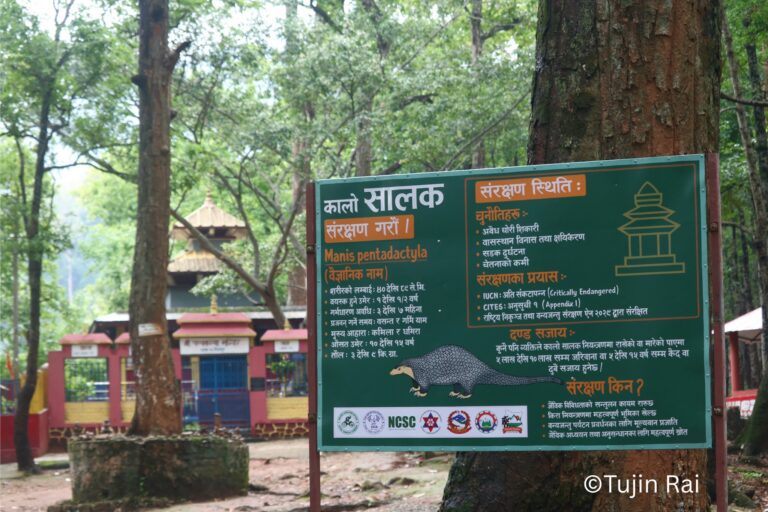
Banner image: Camera-trap photograph of a Chinese pangolin recorded in the Panchakanya forest in Nepal on Jan. 21, 2025. Image courtesy of Tujin Rai/Nature Conservation and Study Centre.

you're currently offline


